Flag of Aragon is the traditional kings of Aragon, once used exclusively by the owner of the Crown and expressive of their sovereignty. Attested documented use by Alfonso II, this flag and weapons that come are universally known as "Aragon".
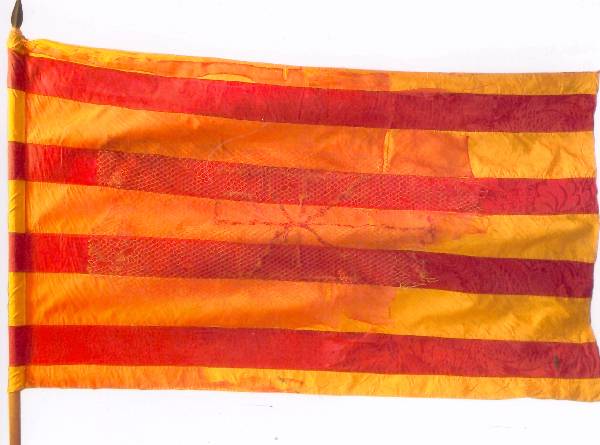
Flag of the thirteenth century, 107 x 173 cm
Preserved in the city of Daroca.
Daroca, thanks to his outstanding participation in decision-Valencia, kept the flag with the actual signal according to tradition was placed in the Muslim walls of the city, on the site of the current door Serranos, by the troops during their decision darocenses in 1238 and then was given by James I to their city as a reward.
In its center there is a Constantinian labarum embroidered the remains of taffeta and satin of the thirteenth century two flags, restored in the twentieth century together by joining the two tissues into one with two faces. The City Council has Daroca that carried in procession on the feast of Corpus Christi.
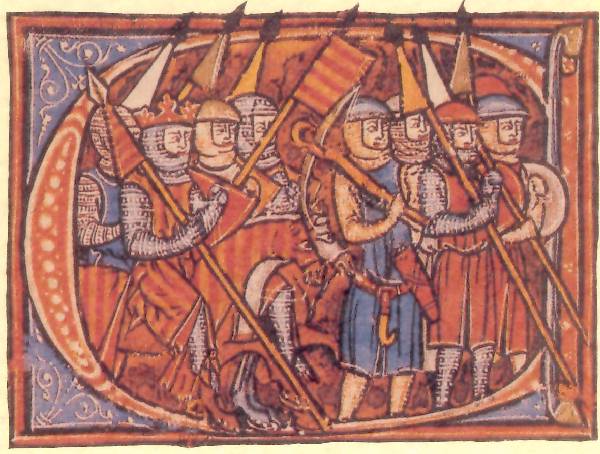
Mayor Vidal XIV century.
The use of real signal on a flag has a long tradition, is reflected for example in miniature of Vidal Mayor (folio 232 v, expeditionibus: es assaber: De caualgadas o corridas) from the beginning of s. XIV (The Paul Getty Museum, Malibu USA).
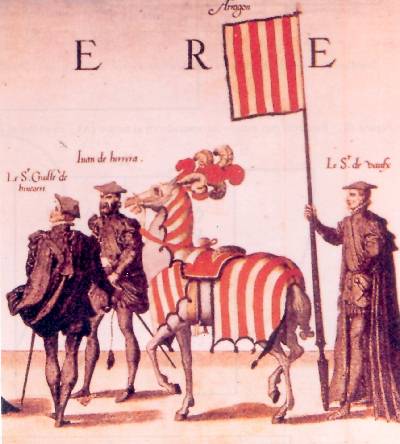
Flag representative of Aragon at the funeral of Emperor Charles, in 1558.
Are common elements of the Flag and the Coat the "sticks gules 'or' bars of Aragon", common historical element of the existing four regional bodies that once were part of the Crown of Aragon, in which are still iconic, and in its representation joined the Shield of Spain.
In accordance with the provisions of Article 3 of the Statute of Autonomy, the Flag of Aragon is the traditional four horizontal red stripes on yellow background.
Text drawn from the Law 2/1984 of 16 April, on the use of the Flag and the Coat of Aragon.
Literature: BLASON DE ARAGON. EL ESCUDO Y LA BANDERA, de Guillermo Fatás y Guillermo Redondo. Ed. Diputación General de Aragon. Zaragoza, 1995.
Más páginas sobre el escudo de Aragón
- Coat of Aragon
- Another traditional representation of the shield
- Law 2/1984 on use of the Flag and the Coat of Aragon
- Personal page
- Stone Shield (800 x 600) 91 Kb
- download page

Other items on Heraldry of Aragon
- Basics
- Coat of Aragon
- Coat of province Huesca
- Coat of province Teruel
- Coat of province Zaragoza
- Alphabetical index on Shields
- Flags and Emblems criteria for counties
- Decree 1/1992 Decree on rehabilitation and modification of Flags and Emblems
- Flag of Aragon.
- Alphabetical Index of Surnames Aragonese
- Libro del Conocimiento (Book of Knowledge).
Ample your information on Aragón
If you want Ample your information on Aragon you can begin crossing some Monasteries, our 40 Castles another interesting route is the Mudejar, Patrimony of the Humanity, also you can extend your cultural knowledge on Aragón examining its municipal and institutional heraldica without forgetting, of course, some of its emblematicas figures as San George Pattern of Aragon or its personages I illustrate adding to these data a minimum crossed by its history o some books.
Also Aragón enjoys a diverse and varied Nature where passing by plants, animals, or landscapes we can arrive at a fantastic bestiario that lives in its monuments.
The information will not be complete without a stroll by its three provinces: Zaragoza, Teruel y Huesca y sus varied Regions, with shutdown in some of its spectacular landscapes like Ordesa or the Moncayo or by opposition in the valle of the Ebro.
If reasons of work or relatives have taken to you Far from Aragon you can Download images of bottom, sounds or animations
Also you can dedicarte to the intangible ones: from the legend compilation that also does to universal Aragon you can persecute the presence of Santo Grial in Aragon.
Other pages on Aragon in Internet
Zh2o |
Huesca |
Teruel |
Zaragoza |
Aragon |
Regions |
Beginning
Books |
Shields |
Rural Tourism |
Sports |
Precipices |
Tourism
La Seo |
El Pilar |
Mudéjar |
Goya |
History |
Zaragoza Museum
Water |
Fauna |
Flora |
Geology |
Fungi |
Nature in Aragón
Alphabetical Indice |
Thematic |
Maps |
Other Directions
Bandera de Aragón
Copyright 2000-2026 © All Rights Reserved Francisco Javier Mendivil Navarro, Aragon (Spanien)
Erläuterungen oder um Fehler zu korrigieren klicken Sie bitte hier
Rechtlicher Hinweis. Diese Aktivität der Asociación Cultural Aragón Interactivo y Multimedia
Die gesamte Verwaltung bzw. öffentliche Einrichtung erfolgt eigenständig.
Im Gegensatz zur Drohung der Hoffnung der Wassertrasvase: HERZLICHEN GLÜCKWUNSCH.